
Dryer vent replacement in New York City
Some dryer vents cannot be cleaned or patched into good shape: the material is wrong, the route is too long or the line is worn out. We take out the old hose and install metal duct, by a shorter and straighter route where the building allows, with a new hood outside.
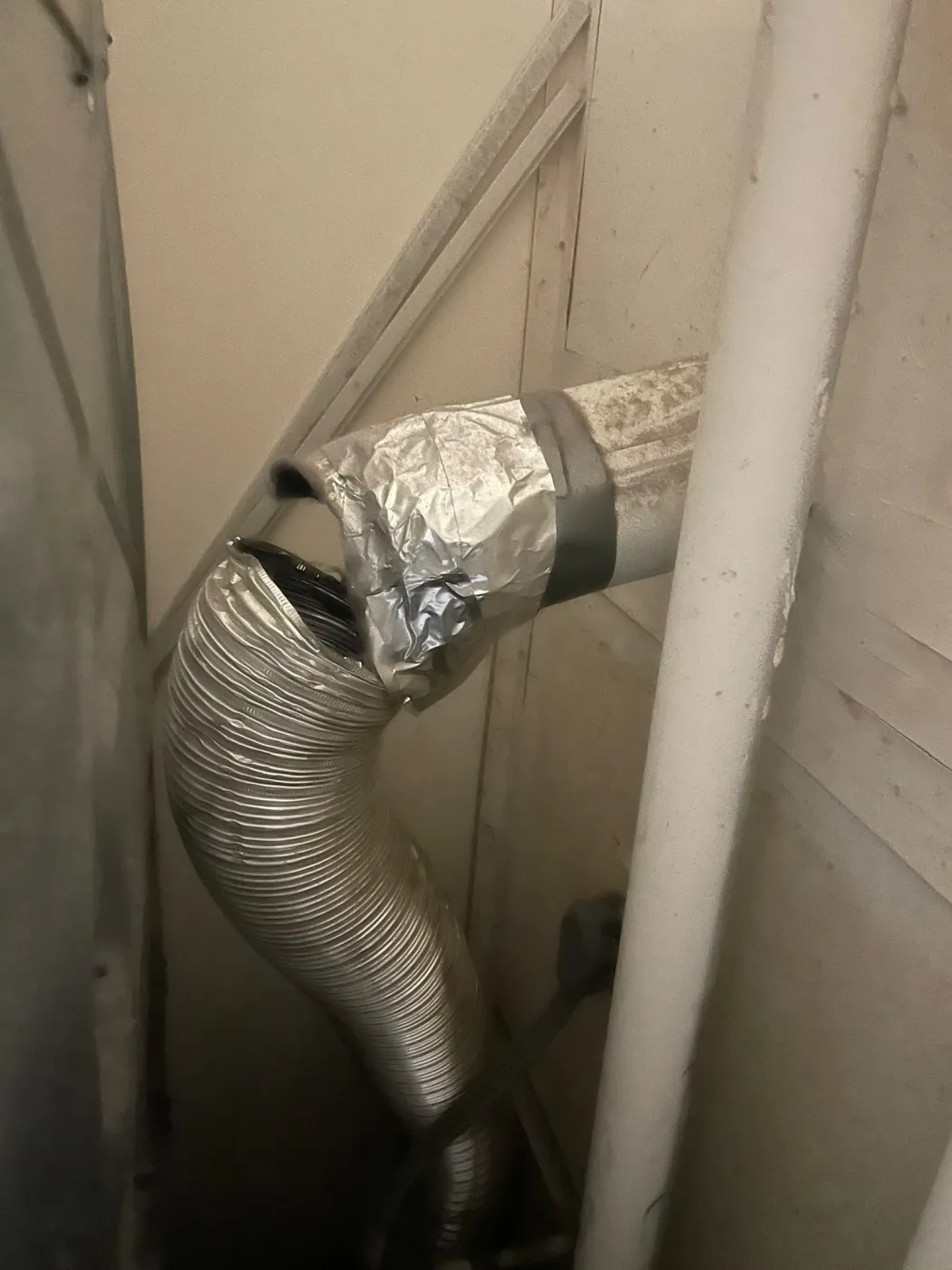
Dryer vent replacement, explained
Replacement means the old vent comes out and a new one goes in. Sometimes that is only the connector behind the dryer. Sometimes it is the whole run to the outside wall, plus the hood. The aim is smooth metal walls, few turns, tight joints and an outlet that opens fully.
The most common reason is material. White plastic or vinyl hose is still found behind many dryers. It sags, its ridges hold lint and it does not stand up to heat. Thin foil hose is a step up, but it crushes and tears easily, and neither kind belongs inside a wall or ceiling. Metal duct with a smooth interior gives lint far less to cling to and holds its shape.
The second reason is the route. A vent may wander across a basement or carry more hose than the distance needs. Every extra length and every bend slows the air and gives lint a place to settle. In a row house or a renovated apartment there is often a more direct way out.
The third is wear: a line patched in several places, flattened along its length or corroded. At that point each repair buys little. To have a line looked at, text DRYER and your ZIP code to (917) 983-1283.
What is included
- Old plastic, vinyl or worn foil hose removed and taken away
- New metal duct installed with as few bends as possible
- Joints fitted in the direction of airflow and sealed with foil tape
- A new connector between the dryer and the wall, cut to length
- A new outlet hood with a flap, sealed to the wall
- Photos of the old line and the new one
Signs you need it
- White plastic or vinyl hose anywhere in the line
- Foil hose running through a wall, ceiling or crawl space
- Extra hose coiled or looped behind the dryer
- A vent that clogs again soon after each cleaning
- A vent that ends in a basement, attic or crawl space instead of outdoors
How the job goes
Assess the old line
We look at what the vent is made of, how it runs and where it ends, and tell you whether repair or replacement makes more sense.
Plan the route
We work out the most direct path to the outdoors that the building allows and show you where the duct and the outlet would go. The quote comes now, before anything is removed.
Remove the old vent
The dryer is disconnected and the old hose or duct is taken out, along with the lint around it.
Install metal duct
New duct is run along the planned route and supported so that it does not sag, with every joint sealed with foil tape.
Fit the hood
A new hood with a flap goes on at the outside wall, and the gap around it is sealed.
Connect and test
A new connector joins the dryer to the wall without kinks. The dryer runs, and we check the air at the outlet and at each joint.
Why it matters
A dryer can only push air so far. Each added length and each bend takes some of that push away, so a long, twisting line moves less air even when it is clean. A shorter, straighter one dries faster and stays clear for longer between cleanings.
Material matters for safety. If lint ever ignites inside the line, metal duct is far more likely to contain it, while plastic hose softens and fails. That is why dryer makers warn against plastic and vinyl hose.
Dryer vent replacement: common questions
When does replacing beat repairing?
When the problem is the line itself and not one part of it: plastic or vinyl hose, foil hose hidden in a wall, a route with more length and turns than it needs, or damage in several places. A single loose joint or a crushed connector on an otherwise sound metal line is a repair.
Is flexible foil hose ever acceptable?
As a connector between the dryer and the wall, in plain sight, flexible metal hose is normal. It should be no longer than the gap needs and never crushed behind the machine. It is not meant to run through walls, ceilings or floors, where it sags and cannot be seen or easily cleaned.
Can you move the outlet to a different wall?
Often, yes, if a shorter path to the outdoors exists. In an apartment building, a co-op or a landmark district, a new opening in an exterior wall usually needs approval first, so check with your management or board.
Does a new vent still need cleaning?
Yes. Smooth metal duct holds less lint than ridged hose, but every dryer sends some lint down the line. Have the vent checked and cleaned on a regular schedule.
Related dryer vent services
Tell us what is going on. We will tell you what it needs.
Call or text with your ZIP code and a line about the problem. For dryer vents, text DRYER and your ZIP.