Chimney inspection in New York City
Most chimney damage sits where you cannot see it: up on the roof or inside the flue. We check the chimney outside and inside and show you photos of each thing we find.
Chimney inspection, explained
A chimney inspection answers one question: is this chimney sound and safe to use as it is. It is a check of the whole structure, not a cleaning, though it often tells you a cleaning is due.
Outside, we look at the cap, the crown, the bricks and mortar joints of the stack, and the flashing where the chimney passes through the roof. Inside, we look at the firebox, the damper, the smoke chamber and the flue liner along its length. On a boiler or furnace flue, the pipe from the appliance, its connection at the chimney wall and the cleanout at the base are part of it.
NFPA 211, the standard that covers chimneys, fireplaces and vents, calls for an inspection at least once a year. Some moments call for one outside that routine: when you are buying or selling a home, after a chimney fire, after a severe storm, and after you change the appliance or the fuel, such as a new boiler or a switch from oil to gas.
New York adds its own reasons. Many chimneys here are older than anyone's records and stand on flat roofs where nobody sees the top from the street.
What is included
- Cap and its mesh screen
- Crown, bricks and mortar joints of the stack
- Flashing where the chimney meets the roof
- Flue liner checked for cracks, gaps and blockages
- Smoke chamber, damper and firebox
- Connector pipe and cleanout on a boiler or furnace flue
- Photos and a plain account of what we found
Signs you need it
- No inspection in the past year
- You are buying or selling the property
- A chimney fire, even a small one
- A storm that brought down branches or shifted the cap
- A new boiler, furnace or insert, or a change of fuel
- Water stains on a ceiling or wall near the chimney
How the job goes
Ask what it serves
We start with what the chimney is connected to, whether a fireplace, a boiler, a furnace or a water heater, and what has changed since it was last checked.
Check the firebox
The firebox walls and floor, the damper and the smoke chamber are examined with a light for cracks, gaps, rust and missing mortar.
Look up the flue
The liner is examined along its height for cracked or shifted tiles, open joints, heavy creosote and anything blocking the passage. If soot hides the surface, the flue has to be swept before it can be judged.
Go up top
From the roof we check the cap, the crown, the brickwork and the flashing, and look down the flue from above.
Check around it
Where they can be reached, the attic, ceilings and walls next to the chimney are checked for stains that point to a leak.
Report back
You get the photos and a clear list: what is fine, what to watch and what needs work. Any repair is quoted before it starts.
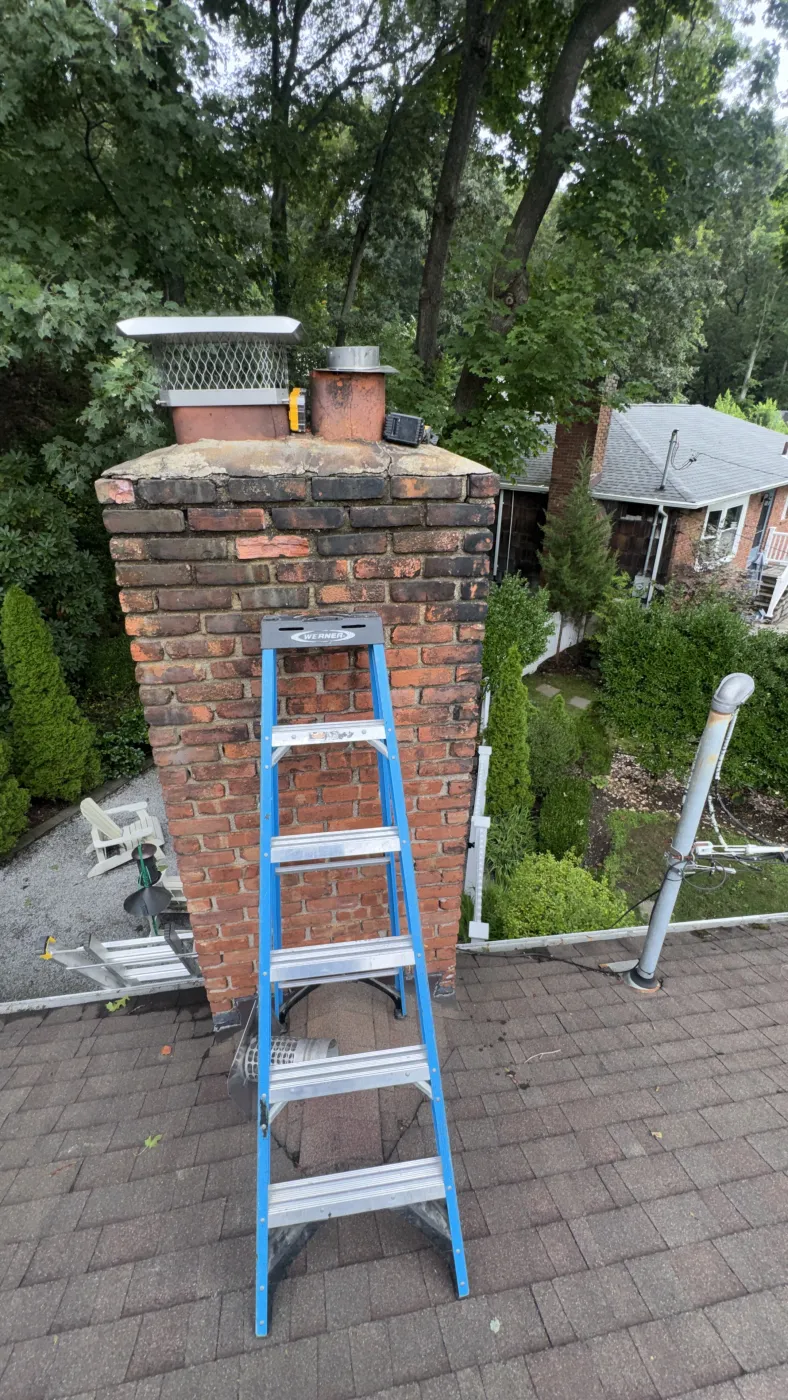
From our own jobs
Our photos, not stock.
Why it matters
A chimney can look fine from the living room and still have a cracked liner, a crown that lets water in or a flue half closed by fallen brick. None of those announce themselves until there is smoke in the room, a stain on the ceiling or, with a heating flue, carbon monoxide in the building.
An inspection also keeps the work in proportion. It separates the chimney that only wants a sweep from the one that needs repair, and it puts the evidence in front of you in photos.
Chimney inspection: common questions
Is an inspection the same as a sweep?
No. A sweep removes soot and includes a basic look at the chimney. An inspection is the closer check of every part, inside and out, whether or not the flue needs cleaning.
I am buying a house. Does the home inspector cover the chimney?
Usually only what can be seen from the ground and from the room. The inside of the flue, the crown and the cap fall outside most general home inspections, so a chimney inspection before closing tells you what you are taking on.
How do I know if I have had a chimney fire?
Some are loud, with a roar and dense smoke. Others burn slowly and go unnoticed. Afterward the signs are inside the flue: cracked tiles, creosote puffed up into a light, honeycombed crust, a warped damper or a discolored cap. Do not use the fireplace again until it has been checked.
Do you inspect boiler and furnace chimneys?
Yes. Those flues carry exhaust every day of the heating season, and a blockage can send it back into the basement. The check covers the flue, the pipe from the appliance and the seal where that pipe enters the chimney.
Related chimney services
Tell us what is going on. We will tell you what it needs.
Call or text with your ZIP code and a line about the problem. For dryer vents, text DRYER and your ZIP.