
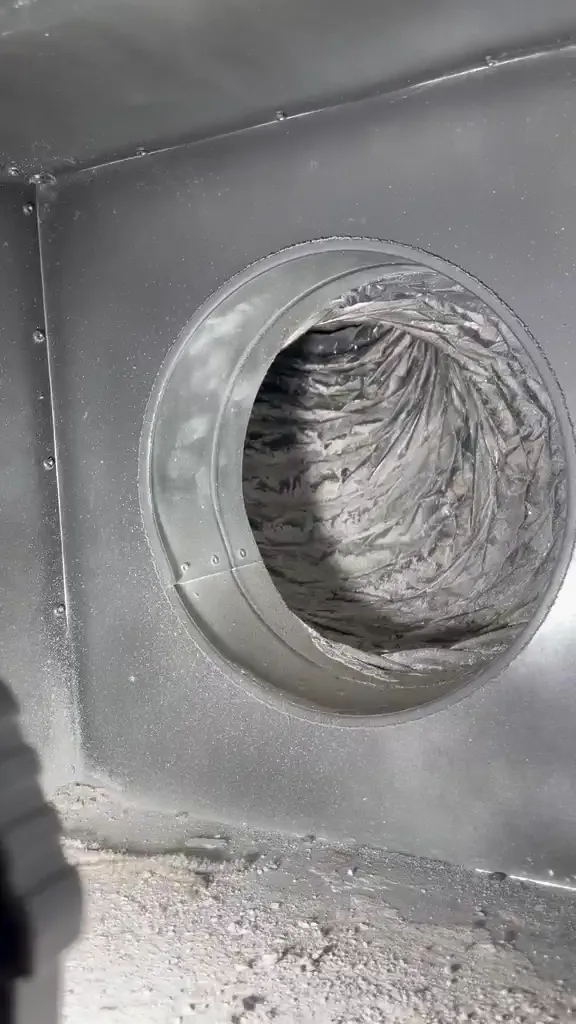
How the dust gets in
The return side of a forced-air system is under suction whenever the blower runs. Sanding joint compound, cutting wood and tearing out plaster all put fine dust into the air, and it hangs there long after the tool stops. The nearest return grille pulls it in.
The second route is more direct. Registers come off so floors can be laid or walls painted, and the open duct ends sit uncovered. Floor registers are the worst case. Sweepings, screws, chips of plaster and offcuts drop straight down, and a broom pushes more in after them.
The third route is new ductwork. When central air goes into a house as part of the renovation, the ducts are installed early, while the walls are still open. If the ends are not capped, they collect dust through every stage that follows. A system like that can be dirty before it has ever been switched on.
Why the filter does not stop it
The filter catches part of the dust, and fine dust loads it quickly. A filter that would normally hold up for a long stretch can clog partway through a single job. Once it is clogged, air takes the easy path around the edges of the frame, and the dust goes with it.
Sometimes the filter gets pulled out because the system is struggling, and nobody puts a new one in. Then there is nothing between the returns and the equipment at all.
And the filter only protects what is downstream of it. When the filter sits at the air handler, the return ducts are upstream of it, so whatever enters a return grille settles in those ducts no matter how good the filter is.
What the dust does once it is inside
Dust that gets past the filter reaches the equipment. In cooling season the coil is wet, and drywall dust sticks to a wet surface and dries into a crust. A coated coil moves less heat. At the blower, dust packs onto the blades and cuts the air the fan can move. What is left carries on into the supply ducts and settles along the runs.
After that, the system hands a little of it back each time it starts. This is the dust that keeps showing up on the windowsills long after the contractor's final cleanup, in rooms that were never part of the work.
What to do while the work is going on
Most of this can be prevented with a few habits on the job.
- Turn the system off during sanding, cutting and demolition
- Cover supply and return openings in the work area with plastic sheeting and tape
- Cap the open ends of any new or disconnected ductwork
- Leave the covers on until the dusty work and the cleanup are both done
- Never run the system with the filter out
- Check the filter often and change it as soon as it loads up
If you need heat or cooling during the job
One caution. A system should not run with most of its openings sealed, because the equipment needs air moving across it. Talk it through with the contractor beforehand, so the work area is closed off from the rest of the home and the rooms you are living in can still be served.
What to do after the work
Wait until the last dusty trade is finished. That usually means after the final sanding and floor finishing and after the cleanup, and before or just after you move back in. Cleaning the ducts in the middle of a project means cleaning them twice.
A post-construction cleaning covers the return and supply ducts, the registers and grilles, and the plenums at the air handler. The coil and the blower are checked, because that is where fine dust does the most harm, and cleaned if they need it. The last step is a new filter. Our after-renovation air duct cleaning page walks through the visit, and coil cleaning and blower cleaning each have their own page.
Check the new filter again after the system has run for a while. It often picks up a last round of fine dust from the rooms themselves.
The New York version of the problem
Renovation here is rarely gentle. Gutting a brownstone or a pre-war apartment means taking down plaster and lath, which comes off the wall as heavy, gritty dust mixed with old soot. Space is tight, so the air handler closet often doubles as storage for the job, and the return grille sits close to the saw.
In an apartment building you may also be living through someone else's renovation. If your system serves only your apartment, work next door does not go straight into your ducts, but dust from the hallway comes in under the door and your returns pick it up like any other dust. A fresh filter when the neighbor's job ends is a sensible habit.
If you are not sure how your system came through a project, we can look inside and send you photos of what is there. The quote comes first, and the number to call or text is (917) 983-1283.
Related services
Call or text (917) 983-1283 for a quote.