
What a PTAC unit is
PTAC stands for packaged terminal air conditioner. Packaged means everything is in one box: the compressor, two coils, the fans and the controls. Terminal means it serves the room it sits in. There are no ducts.
The unit slides into a metal sleeve built into the outside wall. On the room side you see a cover with a grille, a filter behind it and the controls. On the street side there is a louvered grille set into the face of the building. Cooling works the same way as in a window unit. Heat comes from an electric element or a heat pump inside the unit, or in many New York buildings from a hot water or steam coil fed by the building's boiler.
You find them in post-war apartment buildings, hotels and offices, one per room, lined up under the windows.
Why it gets musty
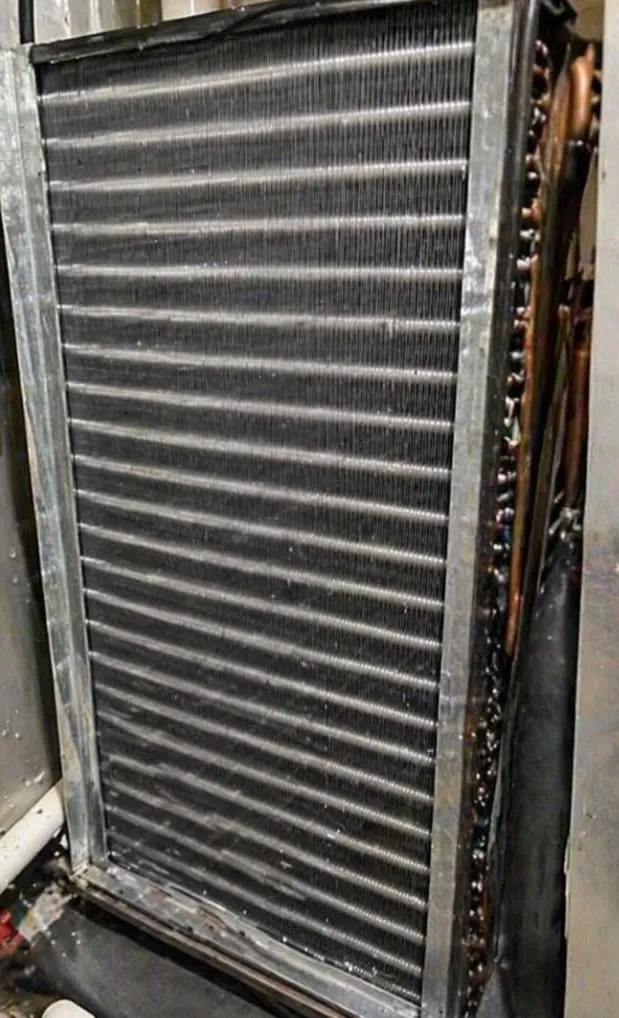
When the unit cools, it also pulls moisture out of the room air. That water condenses on the cold indoor coil and runs down into a pan at the bottom of the unit. From there it is meant to leave toward the outdoor side.
Now add dust. Whatever gets past the filter lands on a wet coil and stays there. Dust also settles in the pan and turns to sludge. Wet dust in a dark box is where the musty smell comes from, and it is strongest just after the fan starts, when air passes over everything that grew while the unit sat.
A filter that is clogged, torn or missing speeds all of this up. So does a long idle stretch with water left standing in the pan.
Why it drips
A dripping unit is more than a puddle on the sill. In an apartment building the water can run inside the wall and show up as a stain on the ceiling of the apartment below.
Water on the floor, on the sill or down the wall below the unit has a short list of causes.
- Drain passages blocked with sludge, so the pan overflows on the room side
- A unit or sleeve that has settled and now tilts toward the room instead of toward the outdoors
- A coil so clogged that it ices over, then melts when the unit cycles off
- Rain driven in through a damaged outdoor grille or a gap around the sleeve
Other signs it needs cleaning
Smell and water are the loud signs. The quieter ones all come back to airflow. A coil matted with dust cannot pass air. A blower wheel with dust caked on its blades moves less air and can run out of balance, which is where much of the noise comes from.
Watch for these.
- Weak air from the grille even on the high fan setting
- A unit that runs constantly and never quite cools the room
- Rattling, humming or a scraping sound from the fan
- Dust or dark flecks blowing out when it starts
- Frost or ice visible on the coil behind the filter
What you can do yourself
Clean the filter. On most units it slides or lifts out from behind the front cover. Vacuum it or rinse it, let it dry completely and put it back. Wipe the front cover and the grille, and keep curtains, furniture and bedding from blocking the front.
Leave the rest alone. Do not spray cleaner or air freshener into the unit, which only adds residue for dust to stick to. Do not pull the chassis out of the wall yourself. It is heavy, it is connected to the building's power, and once it is out there is an open hole in the outside wall.
How a PTAC is cleaned
A real cleaning happens with the unit out of its sleeve. The power is shut off, the front cover and filter come off, and the chassis slides out so every side can be reached.
Both coils are cleaned, the indoor one that cools the room and the outdoor one that sheds the heat. The outdoor coil faces the street and collects soot, grit, leaves and feathers, and when it is blocked the unit works harder for less cooling. The blower wheel and the outdoor fan are cleaned. The drain pan is emptied and scrubbed and its drain passages are opened. The wall sleeve is vacuumed and wiped out. Then the unit goes back in, sitting so that water runs outward, and it is run to check airflow and drainage.
That is the work described on our PTAC cleaning page. If mold was found, the cause is still moisture, and the drainage has to be put right too.
If your apartment has a central air handler in a closet instead of units under the windows, the equivalent job is HVAC unit cleaning, often together with coil cleaning.
Who looks after it in an apartment
It depends on the building. In a rental the units usually belong to the landlord. In a co-op or condo the unit is often the owner's responsibility, while the sleeve and the outdoor grille may belong to the building. Ask management before the cooling season, not during the first heat wave.
Buildings and hotels with many units are better off having them all done in one visit. Call or text (917) 983-1283 for a quote.
Related services
Call or text (917) 983-1283 for a quote.