
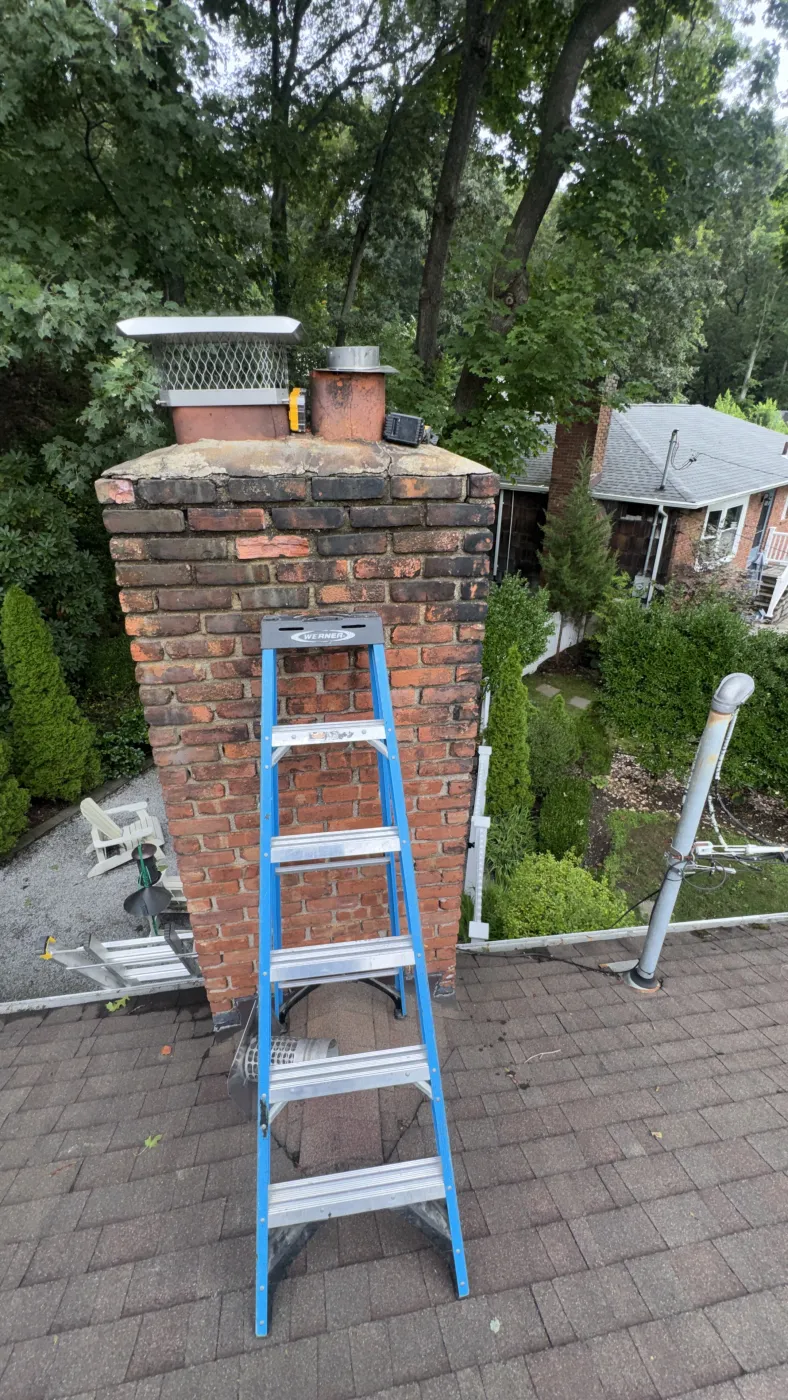
Outside, from the roof
The outside half happens on a ladder or on the roof. On the flat roofs of row houses, the chimney often rises along a shared wall and carries more than one flue, so each flue opening is checked on its own.
Staining is read along the way. A white, powdery bloom on the brick is salt left behind by water that has moved through the masonry. Dark streaks below the top can mean soot or water running where it should not.
The check starts at the top and works down.
- The cap: present, firmly attached, mesh intact, not rusted through
- The crown: cracks, crumbling edges, gaps where it meets the flue
- The bricks: flaking faces, cracks, loose or missing pieces
- The mortar joints: sandy, recessed or open
- The flashing: lifted edges, rust, cracked sealant where the chimney meets the roof
- The stack as a whole: leaning, bulging or staining
Inside, from the firebox up
The inside half starts at the fireplace opening and follows the path the smoke takes.
In the firebox, the bricks and the joints between them are checked for cracks, gaps and loose pieces. The damper is worked through its full travel to see that it opens all the way, closes, and is not rusted or warped. Above the damper is the smoke chamber, where the wide firebox narrows to meet the flue. Soot collects on its sloped walls, and rough or broken surfaces there slow the smoke.
Then the flue. It is looked at from below and from the top for cracked or missing clay tiles, open joints between tiles, flaking surfaces, and anything blocking the passage, such as a nest, leaves or fallen brick. The deposits are part of the reading too. Loose, flaky soot brushes away. A hard, shiny glaze of creosote is a different matter and has to be dealt with before the fireplace is used again.
Signs of water count as findings: rust on the damper, stains on the firebox walls, a damp smell.
When the chimney vents a boiler or furnace
Many New York chimneys have nothing to do with a fireplace. The only thing they carry is exhaust from the heating plant in the basement: an oil or gas boiler, a furnace, a water heater. They need the same yearly look.
Here the inspection covers the metal connector pipe from the appliance to the chimney, checking for rust, holes, loose joints and a steady upward slope. It covers the joint where the connector passes into the masonry, and the cleanout door at the base of the flue along with whatever has collected behind it. When this kind of flue is blocked or leaking, the exhaust has nowhere to go but indoors, and it carries carbon monoxide. This is not the part to skip. Our boiler chimney cleaning page covers what happens when the base is full of soot and debris.
When to have one
NFPA 211 says chimneys, fireplaces and vents should be inspected at least once a year. Early fall is the practical time, ahead of the first fire and the first cold snap, while repairs can still be done in mild weather.
Some events call for an inspection whatever the date.
- Buying a home with a fireplace or an old chimney
- Any chimney fire, however minor it seemed
- A severe storm, a lightning strike or a fallen limb
- A new appliance, or a change in the fuel it burns
- Smoke coming into the room, a new smell or water stains near the chimney
- Bits of tile, brick or mortar turning up in the firebox
- A fireplace that has sat unused for years
What an inspection is not
It is not a sweep, although the two usually happen in the same visit. A flue coated in soot hides its own cracks, so the cleaning often has to come first for the liner to be seen properly.
It is also limited to what can be reached and seen. Parts of a chimney run behind walls and through floors. Those are reported as not seen, not guessed at. If something points to hidden damage, you are told what was found and why a closer look is worth it.
What you get at the end
You should come away knowing three things: what is sound, what needs attention now, and what can wait and be watched. We go through the photos with you in plain terms, and you have a quote in hand before any repair goes ahead.
The service itself is described on our chimney inspection page. If the flue needs cleaning, that is a chimney sweep. If the inspection turns up cracked brick, a failed crown or a leak at the flashing, chimney repair explains the next step. Call or text (917) 983-1283.
Related services
Call or text (917) 983-1283 for a quote.