
What changes when the fuel changes
An oil boiler sends hot exhaust up the chimney. The flue warms quickly, stays warm while the burner runs and pulls a strong draft. What it leaves behind is soot.
A gas boiler behaves differently. Burning gas produces a great deal of water vapor, and a modern gas appliance keeps more of the heat in the building, which is the point of it. So the exhaust that reaches the chimney is cooler and wetter than what the flue was built for.
In a tall, cold masonry chimney, that exhaust cools further on the way up. When it cools enough, the vapor turns to water on the flue walls.
What condensation does to an old flue
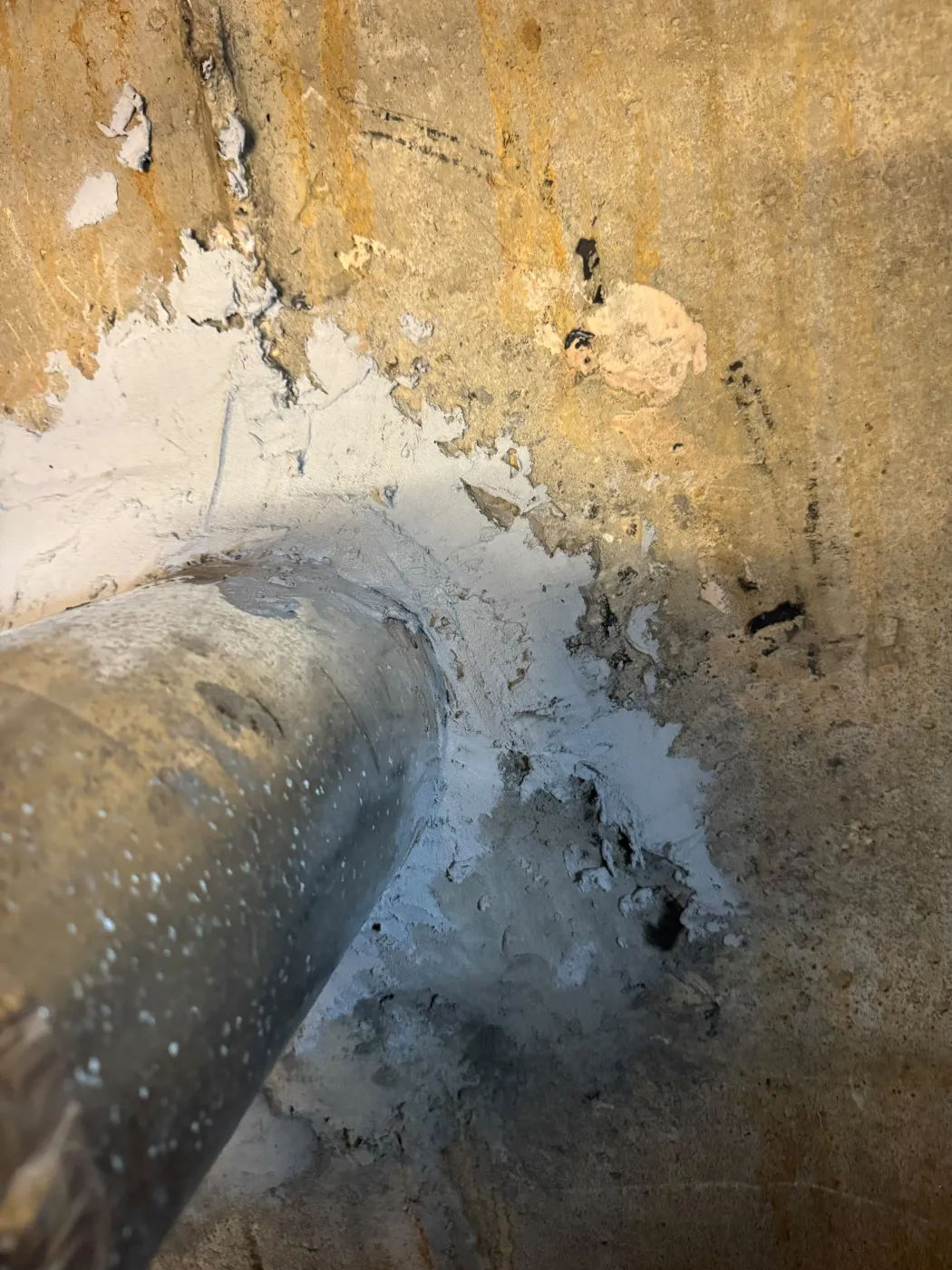
The water that forms is mildly acidic. It also soaks into the oil soot still clinging to the flue, and wet soot is corrosive. Together they attack mortar joints and clay tile.
The damage is slow and hidden. Joints between flue tiles erode. Tile faces flake off. In an unlined brick flue, which many older New York buildings have, the mortar turns sandy and the brick starts to shed. The pieces fall to the bottom of the flue, where they can pile up and narrow the opening the boiler vents into.
Moisture also moves outward through the brick. Indoors that shows as damp patches, peeling paint or crumbling plaster on the wall the chimney runs behind. Outdoors it shows as white staining, and on an exposed chimney the winter freeze and thaw speed everything up.
Why the flue is suddenly the wrong size
A flue that suited an oil boiler is often larger than a gas appliance needs. In an oversized flue the exhaust moves slowly, loses its heat to all that masonry and drafts weakly. Slow, cool exhaust is exactly what condenses.
A second change can make it worse. Some high-efficiency gas boilers do not use the chimney at all and vent through their own pipe. That can leave a gas water heater alone on a flue sized for a boiler. One small appliance cannot keep a big flue warm, so its exhaust condenses even more readily, and it may not draft properly.
What a liner does
A liner is a continuous metal pipe that runs inside the old flue from the appliance connection to the top of the chimney, finished with a cap. It does two jobs. It keeps exhaust and condensation off the masonry, and it gives the appliance a passage of the right size, which warms up fast and drafts the way it should.
In some chimneys the liner is also insulated so the exhaust stays warm on the way up. That matters most on a chimney that stands on an outside wall. See chimney flue installation for how a new flue is fitted and chimney insulation for when insulating one is worth it.
Whether your chimney needs a liner depends on the appliance, the flue and the condition it is in. Your heating contractor will know what the new equipment requires. The chimney side of the question is what shape the flue is in before anything is connected to it.
Before the switch: clean and inspect
Have the chimney swept before the gas appliance goes in. Oil soot left in the flue is what turns corrosive once it gets wet, and loose soot and scale can fall and block the base later. The cleanout at the bottom should be emptied and the connector pipe checked. Our boiler chimney cleaning page describes that work.
Then have the flue inspected. A chimney inspection shows whether there is a liner now, what state the tile or brick is in, and whether there are gaps, offsets or debris that would get in the way of a new liner.
Signs a converted chimney is in trouble
If the switch was made some time ago and nobody looked at the flue, watch for these.
- White staining or damp patches on the chimney, outside or in
- Peeling paint or soft plaster on the wall in front of the chimney
- Grit, sand or flakes of tile collecting in the cleanout at the base
- Rust on the connector pipe, or water marks at its joints
- A smell of exhaust near the boiler or water heater
If you smell exhaust
That last sign is the urgent one. A flue narrowed by fallen debris can push exhaust, including carbon monoxide, back into the building. Keep working carbon monoxide alarms near the boiler room and the bedrooms. If an alarm sounds or you smell exhaust, get out and call the utility or the fire department.
For everything short of that, call or text (917) 983-1283. We look at the flue and send you photos of its condition, and you see a quote before any work is done.
Related services
Call or text (917) 983-1283 for a quote.