
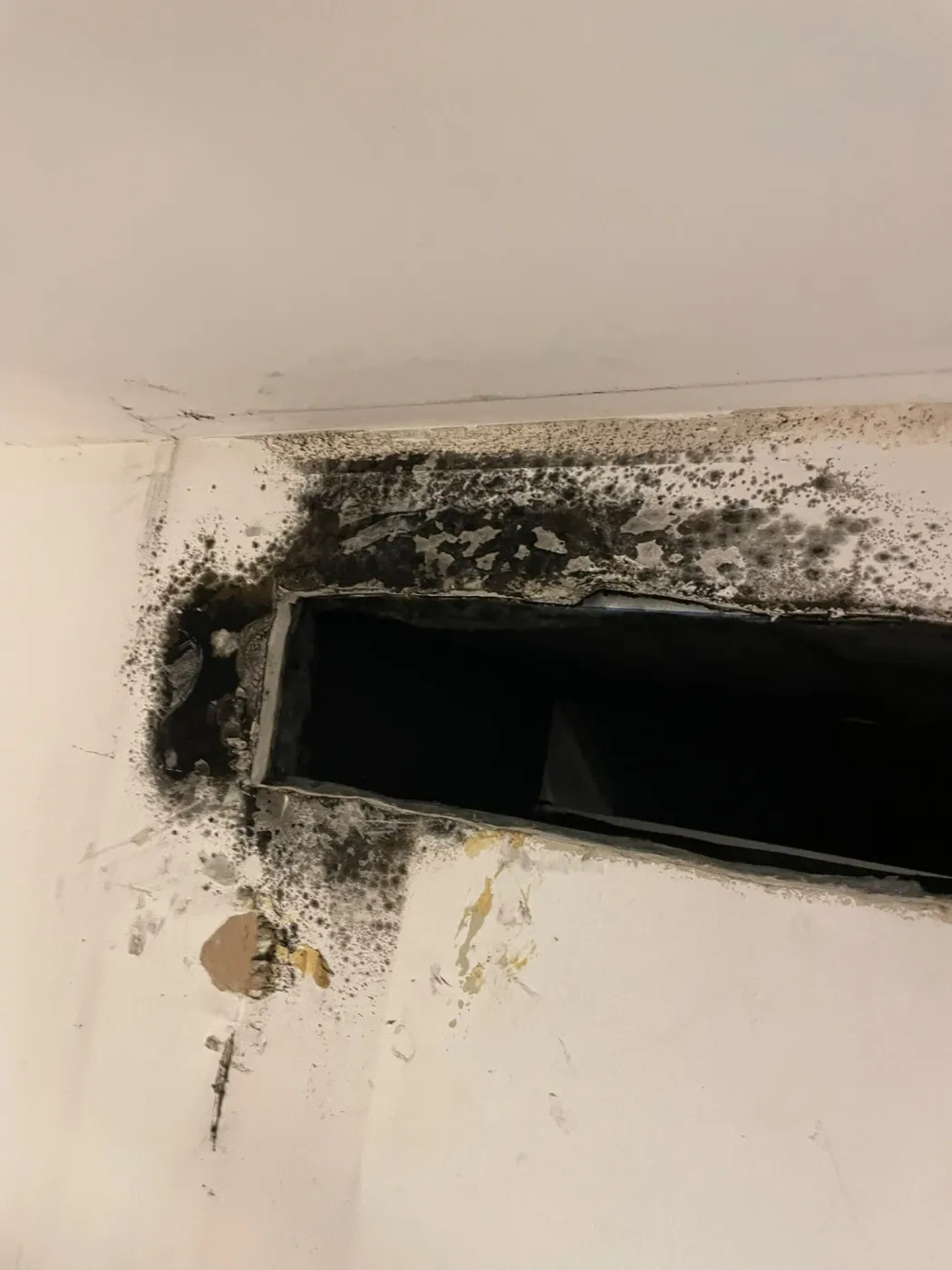
Signs you can see
Start at the registers. If a puff of dust comes out when the system kicks on, or you find grit and debris on the floor under a supply register, that material is coming from inside the duct.
Then look in. Unscrew a register cover and photograph the inside of the duct with your phone's light on. Do the same at the return grille, which is the larger one that pulls air in. The return side is often dirtier, because in many systems air travels through it before it reaches the filter. A light coat of dust is ordinary. What matters is one of the following.
- Dust or debris blowing out of the supply registers
- A thick, matted layer of dust inside the return duct
- Plaster, sawdust or screws left in the duct after construction
- Dark, fuzzy or spotted growth on a register or a duct wall
- Droppings, nesting material or insects in the duct
- A filter that clogs much sooner than it used to
Signs you can smell or hear
A musty smell right after the air starts, fading as it runs, points to moisture somewhere in the system. It may be the ducts. It may also be the coil or the drain pan in the air handler, which stay wet all summer.
A sour or rotten smell that comes and goes with the airflow can mean a pest died in the ductwork. Scratching or rustling from a duct means something is alive in there. Either way, the system needs to be opened and looked at, not sprayed with fragrance.
Signs in how the system runs
Weak air from some registers, rooms that no longer cool or heat the way they did, a system that runs longer to do the same work: these are worth acting on, but they are not proof of dirty ducts.
Dust on duct walls rarely blocks airflow by itself. The usual causes are a clogged filter, a coil matted with dust, a blower wheel with dust packed onto its blades, or a flexible duct that has been crushed or has come off its collar. A proper visit checks those parts too. If the restriction turns out to be at the equipment, the fix is coil cleaning or blower cleaning, with or without the ducts.
Things that are not signs
Plenty of ordinary things get blamed on ducts. None of these, alone, tells you the ducts are dirty.
- Dust on the furniture a few days after you wipe it
- The age of the building or of the system
- A dark smudge on the ceiling beside a register
- A brief dusty smell the first time the heat comes on in the fall
- A higher energy bill with no other symptom
- A flyer or a phone call telling you it has been too long
Why those do not count
New York apartments are dusty because of the city. Dust comes in through windows, on shoes and from fabrics, and it settles whether or not you have ducts at all. Homes with radiators have the same problem.
The smudge beside a register is often room dust, left there as the airstream drags room air across the ceiling. It is a reason to look inside, not a verdict. The smell on the first cold day is usually dust burning off the heating surfaces after a summer of sitting idle. It should fade quickly. If it does not, or if it smells like something other than dust, shut the system off and have it checked.
And an old building does not mean old dirt. A system that has been kept up with good filters can be cleaner than a new one that ran through a renovation.
When the sign is mold
Wiping the register does not solve it. Mold grows where there is moisture, so the first question is what is getting wet: condensation on a cold duct, a drain pan that is not draining, a roof or plumbing leak nearby.
Not every dark patch is mold. Dust stuck to a damp grille looks much the same. In both cases the growth and the dust it sits in are removed, the cleaned ductwork can be treated, and the moisture source has to be fixed too. Our air duct disinfecting page explains where treatment fits and where it does not.
What to do with what you find
If you found one of the real signs, have the whole system looked at, returns and supplies both. We send photos of what is inside and give you a quote before work starts. The air duct cleaning page describes the visit, and you can call or text (917) 983-1283.
If you found none, change the filter, put the covers back and leave the ducts alone. Not every system needs cleaning this year.
Related services
Call or text (917) 983-1283 for a quote.