
Why shared laundry rooms clog faster
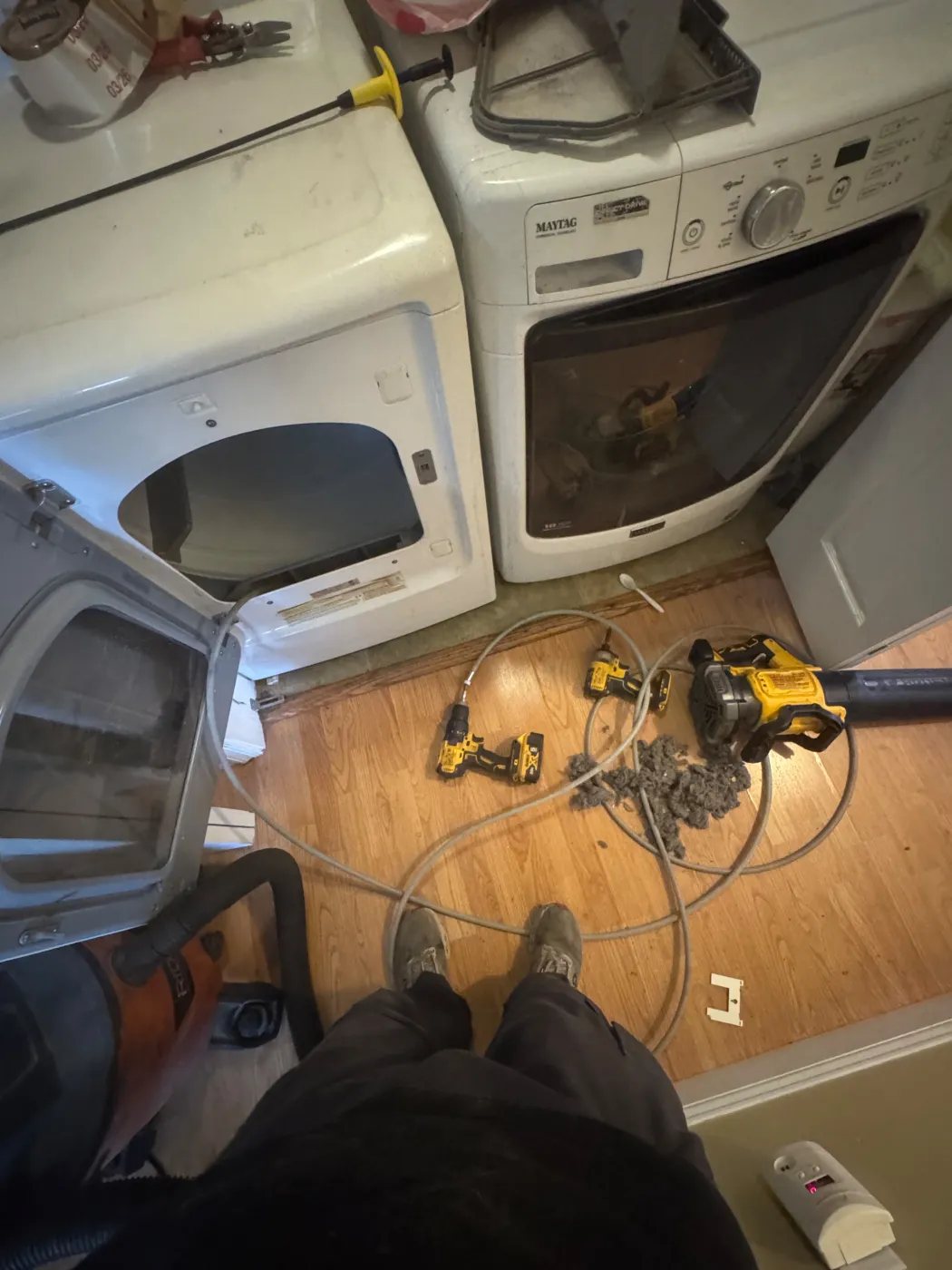
A dryer in a house runs a handful of loads a week. A dryer in a building laundry room runs load after load, all day, for every household in the building. More loads means more lint, and all of it goes into the same duct.
Nobody owns the lint screen, either. Residents in a hurry skip it, and the next load runs against a screen that is already matted.
Then there is the layout. Laundry room dryers usually tie into one common exhaust duct that runs across the basement ceiling to an outside wall or up to the roof. Lint from every machine ends up in that one duct. It settles at each turn and each low spot, and it mats on the louvers or screen at the outlet.
In-unit dryers and shared risers
Buildings with a dryer in each apartment have a different version of the problem. Some units vent straight through their own outside wall. In others, each dryer connects to a vertical riser that serves the whole stack of apartments and ends at the roof, sometimes with a fan at the top to keep the air moving.
A riser collects lint from every floor. A restriction near the top slows every dryer connected below it, and residents on different floors start reporting the same slow drying without knowing they share a cause. If the roof fan is caked with lint or has stopped, the whole stack suffers.
The connections matter as well. Behind each dryer there is a hose, and in a building those hoses are as varied as the residents: crushed, torn, too long, or the thin plastic kind that should not be there at all.
What to schedule
Doing the whole building at once matters. Lint does not respect apartment lines, and cleaning most of the units on a riser while one is skipped leaves that riser only as clear as its worst connection. A sensible schedule looks like this.
- Every in-unit vent cleaned once a year, floor by floor or riser by riser in a single visit
- Shared risers and common ducts cleaned along with the units that feed them
- Laundry room exhaust cleaned more often, at an interval set by how hard the room is used
- Outside hoods, roof caps, flaps and any roof fan checked at every visit
- The hose behind each dryer inspected, and replaced where it is plastic, torn or crushed
- Photos for each unit or line kept with the building's records
What the super can do between visits
A few habits keep the lines clearer between cleanings. The last one, the complaint log, earns its keep. One slow dryer may be the appliance. Several slow dryers on the same duct or the same riser is an airflow problem, and it tells us where to start looking.
- Empty the lint screens in the laundry room every day
- Go outside while the dryers are running and confirm the flap opens and the air is strong
- Keep the space behind and around the machines clear
- Post a sign asking residents to clean the screen before each load
- Log every complaint about slow drying, with the machine or the apartment
Why landlords and boards should care
A dryer fire in a house threatens one household. In a building it threatens everyone on the hallway and everyone above. Lint is what burns in a dryer vent fire, and a shared duct holds more of it.
Moisture is the slower cost. When a concealed joint comes apart, warm wet air and lint blow into the wall or ceiling cavity. The first sign is often a stain on a neighbor's ceiling or a musty smell in a closet. Our dryer vent repair page covers how those leaks are found and resealed.
And restricted vents cost money every day they stay that way. Machines run longer, use more gas or electricity, and wear out sooner. In a laundry room, residents pay for cycles that do not dry and then complain to the office.
Planning the visit
A building visit goes well when access is settled ahead of time. Residents need notice, and each dryer needs to be reachable, with the closet or the space in front of the machine cleared. The super arranges the roof and the basement. Units that cannot be entered should be noted and rescheduled, not forgotten.
We give a quote before work starts and send photos for each unit, so the manager has a record of what was found and what was left behind. The details are on our pages for annual cleaning for property managers and commercial dryer vent cleaning. Call or text (917) 983-1283 to talk through your building.
Related services
Call or text (917) 983-1283 for a quote.