
Three parts, one job
A chimney is a column of brick standing in the weather with a hole down the middle and a roof wrapped around its base. Water can get in at three places: down the open flue, into the top of the masonry, and through the joint at the roof. The cap, the crown and the flashing each close one of them.
Brick and mortar soak up water. Through a New York winter the water held in the masonry turns to ice, swells and melts again many times, and each round opens the joints a little more. Keeping the top of the chimney dry is most of what keeps the rest of it in good shape.
The cap
The cap sits over the flue opening: a metal lid on legs, with mesh around the sides. The lid keeps rain and snow from falling straight down the flue. The mesh keeps out birds, squirrels, raccoons and leaves, and holds back sparks on their way out.
Caps fail by rusting through, by working loose in the wind, or by losing their mesh. A mesh that clogs with soot is a failure too, because it chokes the draft. And a great many older flues in the city never had a cap at all.
The signs of a missing or failed cap show up inside: a wet firebox after rain, rust on the damper, a damp smell, animal noises, twigs and leaves on the smoke shelf. Depending on what is wrong, the fix is chimney cap repair or chimney cap replacement.
The crown
The crown is the masonry lid on the stack: a slab of mortar or concrete spanning from the flue out to the edge of the brick. It is shaped to slope away from the flue so water runs off instead of sitting.
Crowns fail by cracking. On many chimneys the mason simply troweled leftover bricklaying mortar across the top in a thin layer, and that mix does not stand up well to years of sun, rain and frost. Hairline cracks come first. Water gets into them, freezes and widens them. A gap opens where the crown meets the flue tile. From there the water is inside the top courses of brick, and you start to see flaking brick faces, loose bricks and washed-out joints just below the top.
Caught early, cracks are sealed and the crown is coated. A crown that has broken up is removed and rebuilt. Both are covered under chimney crown repair.
A factory-built chimney inside a sided chase has no masonry crown. It has a metal chase cover doing the same job, and that cover fails by rusting and by holding puddles.
The flashing
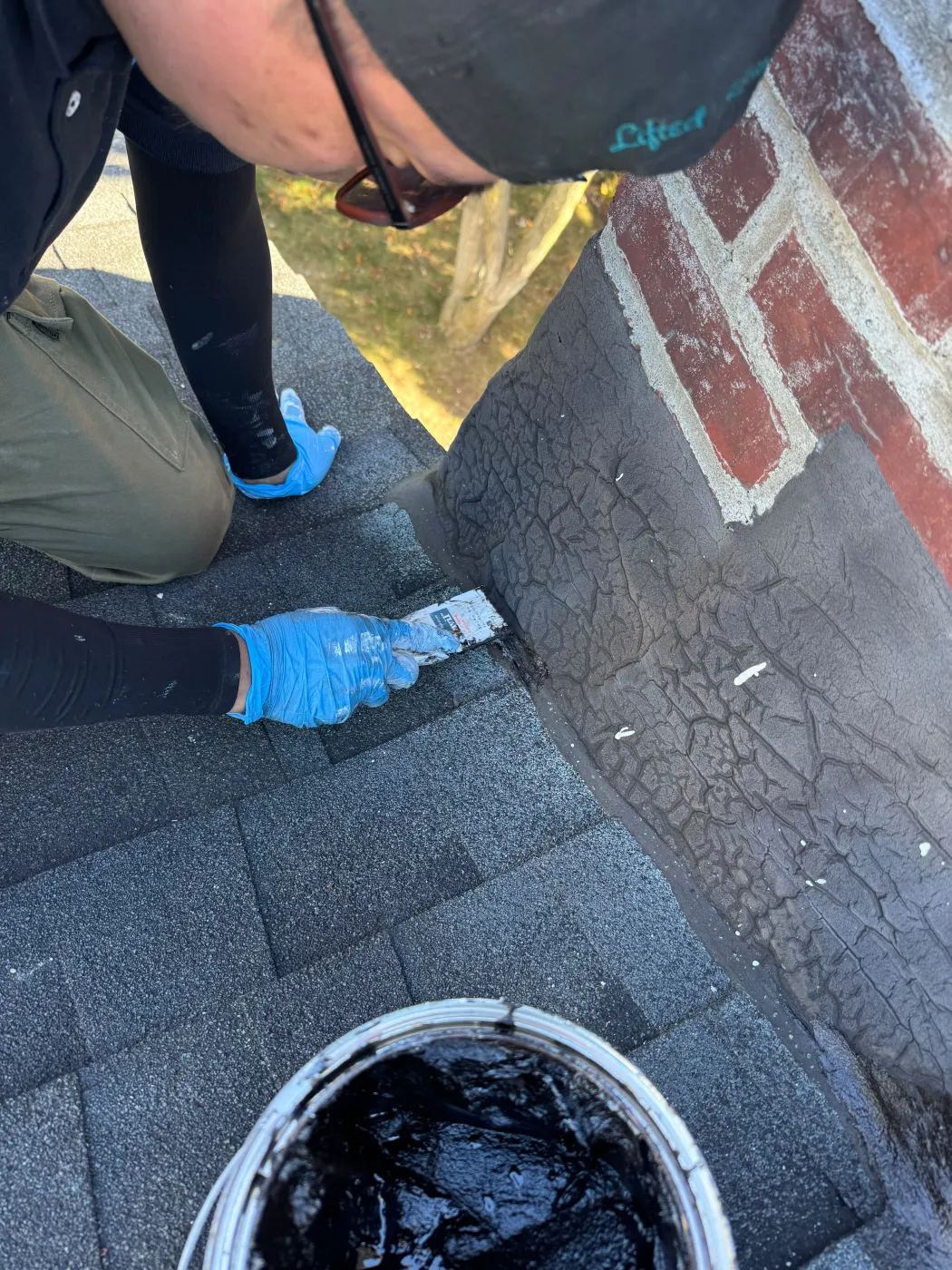
Flashing is the sheet metal that bridges the joint between the chimney and the roof. On a pitched roof it comes in two layers. The lower layer is worked in with the roofing and turns up against the brick. The upper layer is set into the mortar joints and folds down over the lower one, so water running down the chimney is thrown onto the roof and not behind it.
On a flat roof, which is common on New York row houses, the roofing itself turns up the side of the chimney, and the top edge of that turn-up is sealed. That edge is where leaks begin.
Flashing fails when sealant dries out and cracks, when metal rusts or lifts, when the upper layer pulls out of its joint, or when a new roof goes on and the old flashing is reused or smeared over with tar. The sign is a water stain on the ceiling or wall next to the chimney, usually on the top floor, and usually worse after wind-driven rain. Leaks at the flashing are handled as part of chimney repair.
How to tell which one is leaking
Where the water shows up points to the part that failed. Treat the list below as a starting point, not a verdict. Water travels along framing and masonry before it shows itself, and two parts often fail together because they are the same age. A look from the roof settles it. If the joints themselves are worn, that is chimney pointing.
- Water or rust inside the firebox: look at the cap first
- Flaking brick, loose mortar or white staining near the top of the stack: look at the crown
- A stain on the ceiling or wall beside the chimney: look at the flashing
- Damp brick all the way down one side: look at the mortar joints
Small now or large later
All three parts give warning. A hairline crack in a crown, a cap with one loose leg, a bead of sealant starting to split: each is a small repair when someone catches it. Left for a few winters, the same faults let in enough water to loosen brick and stain ceilings.
That is the case for looking at the top of the chimney once a year, before the heating season. We send photos of the cap, crown and flashing as we found them, and nothing is repaired until you have a quote. Call or text (917) 983-1283.
Related services
Call or text (917) 983-1283 for a quote.